
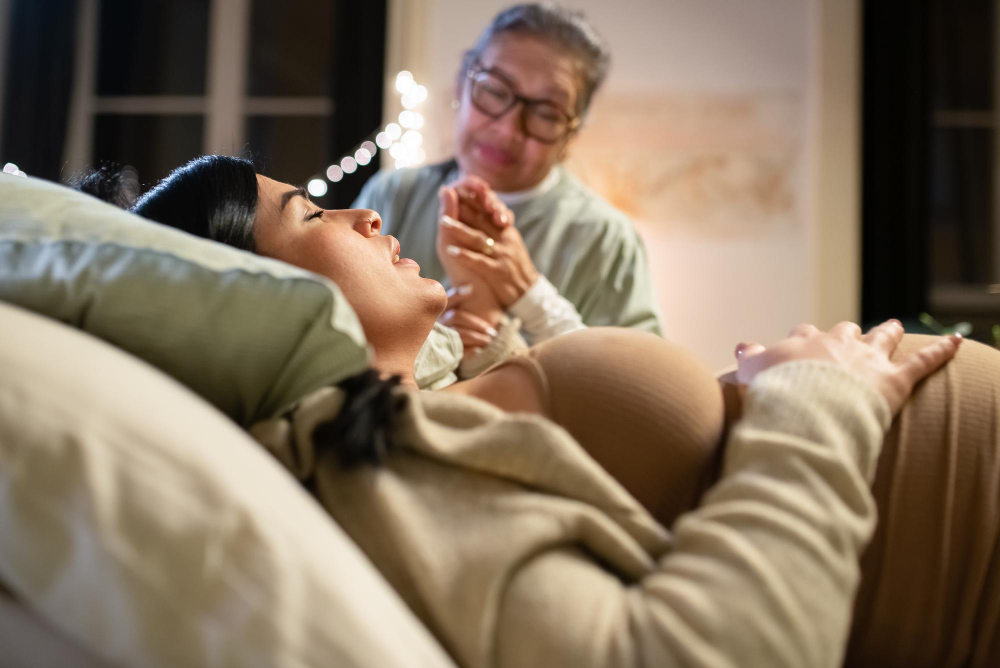
When the same provider walks with you across all of it, everything changes.
What Is Continuity of Care — And Why Does It Matter?
Continuity of care means working with a provider who knows your history, your preferences, your birth story, your baby’s patterns, and your family’s values — across multiple stages of care, not just one.
In most healthcare and perinatal support settings, continuity is the exception, not the rule. You meet a birth doula. She leaves after the placenta is delivered. A postpartum doula comes in — someone new who needs to be brought up to speed. Later, a sleep consultant arrives, asking questions about your baby’s history that you’ve answered twice before.
Every handoff costs time, energy, and trust. And in the postpartum period — when you’re already running on empty — rebuilding that trust from scratch is its own kind of labor.
The Problem With Fragmented Support
You repeat yourself — constantly
Every new provider needs your full story. Your birth experience. Your feeding history. What’s worked and what hasn’t. How your baby responds to being held, to sound, to light. When you’re exhausted and emotionally raw, retelling that story isn’t just inconvenient — it’s depleting.
Context gets lost between providers
A birth doula who knew you labored for 32 hours and delivered via unplanned cesarean carries context that matters for your postpartum recovery. A postpartum doula who watched your baby’s first three weeks of sleep patterns carries knowledge that matters for sleep coaching. When those people are different people with no shared understanding, that context disappears.
Advice can conflict
Different providers sometimes give different guidance. One encourages contact naps freely in the early weeks. Another — coming in later — treats them as a problem to fix. Without a shared philosophy and a shared understanding of your family, the advice you receive can feel contradictory and confusing at exactly the moment you need clarity most.
What Continuity of Care Actually Looks Like
At Bump to Babe, the support model is designed around the whole journey — not a single moment in it.
| Stage | What This Looks Like | How It Connects Forward |
| Pregnancy | Birth preparation, birth plan development, emotional support, building a relationship before labor begins | You arrive at labor knowing your doula. Trust is already established. |
| Birth | Labor support, advocacy, hands-on comfort measures, partner coaching, immediate postpartum support | Your doula already knows your preferences, your fears, your birth story the moment it ends. |
| Postpartum | Newborn care, feeding support, babywearing, parent rest, sleep foundation-building — days and/or overnights, up to 4 months | Sleep patterns, feeding cues, and family rhythms are observed and understood before sleep coaching begins. |
| Sleep Coaching | Customized sleep plan, real-time support, gradual independence-building rooted in everything already known about your baby | No intake from scratch. No rebuilding trust. Just progress, grounded in context. |
That last column matters. Every stage feeds the next — not as a sales funnel, but as a genuine continuum of care that serves your family better than any of its parts could alone.
The Babywearing Piece — And Why It’s Part of This
Starting in 2026, Bump to Babe will add babywearing education to this continuum — becoming the only perinatal professional in and around Baltimore certified through the Center for Babywearing Studies to offer this as part of a full-spectrum care model.
Babywearing isn’t an add-on. It’s a tool for postpartum recovery, for infant regulation, for feeding support, and for building the kind of closeness that makes the harder moments of early parenting more manageable. Having it offered by the same provider who supported your birth and is watching your baby’s sleep development means it gets integrated, not bolted on.
What Full Spectrum Doula Support Really Means
The term ‘full spectrum doula’ gets used in different ways. In Megan’s case, it refers to certification through Doula Trainings International — a credential that encompasses support across the full arc of the reproductive journey, including pregnancy, birth, postpartum, and beyond.
What it means in practice is a framework for care that doesn’t treat any one stage as isolated. Every family’s journey is different. Some begin with birth support and don’t need postpartum doula care. Others start postpartum and move into sleep coaching. Some want all of it from the beginning.
The through-line isn’t a package. It’s a philosophy — that families deserve consistent, compassionate, evidence-based support that meets them where they are and travels with them as they grow.
Who This Model Is Best For
Continuity of care isn’t right for every family — and that’s okay. This model tends to work best for:
- First-time parents who want a trusted guide across the full transition into parenthood
- Families with complex birth histories who need a provider who understands their full picture
- Parents who value consistency and relationship over transactional, single-session support
- Families who want to build healthy sleep foundations from the newborn stage — not scramble to fix sleep problems at 6 months
- Parents who are open to guidance and willing to actively participate in the process
If you’re looking for a one-time consultation, a quick fix, or a provider who will manage your baby’s care without your involvement — this isn’t the model for you. And that’s a fair and honest answer.
Real Families, Real Continuity
One Bump to Babe family began with postpartum doula support in the newborn stage — building feeding routines, learning babywearing, and establishing early sleep foundations with overnight support. When their baby reached the age for more structured sleep coaching, there was no intake, no rebuilding of rapport, no explaining the history from scratch.
The result wasn’t just better sleep. It was a family who felt supported across one of the most challenging transitions of their lives — by someone who actually knew them.
Frequently Asked Questions
What does continuity of care mean in doula support?
It means working with the same provider — or the same care model — across multiple stages of the perinatal journey: pregnancy, birth, postpartum, and sleep coaching. Rather than starting over with a new provider at each stage, you build on an existing relationship and shared understanding.
Can I hire a doula for both birth and postpartum support?
Yes. At Bump to Babe, birth and postpartum doula support are offered together, with postpartum care available for up to four months. That postpartum period can also transition into sleep coaching, making it possible to work with one provider across the full early-parenthood journey.
What is a full spectrum doula?
A full spectrum doula is certified to provide support across the entire reproductive journey — including pregnancy, birth, postpartum, and beyond. Megan holds her full spectrum certification through Doula Trainings International (DTI), a credential rooted in reproductive justice and inclusive, evidence-based care.
How is this different from a doula agency?
Doula agencies often match families with available providers — which means your birth doula and your postpartum doula may be different people. At Bump to Babe, you work directly with Megan across each stage, which means consistent philosophy, consistent presence, and no handoff gaps.
What is babywearing education and how does it fit in?
Babywearing education supports parents in safely and comfortably wearing their baby in a carrier or wrap — a tool that supports infant regulation, postpartum recovery, and feeding. Beginning in 2026, Bump to Babe will be the only certified babywearing educator among perinatal professionals in and around Baltimore, integrating this into postpartum and newborn support.
Ready to talk about what full-journey support could look like for your family?
Book a free discovery call — no pressure, just a conversation.